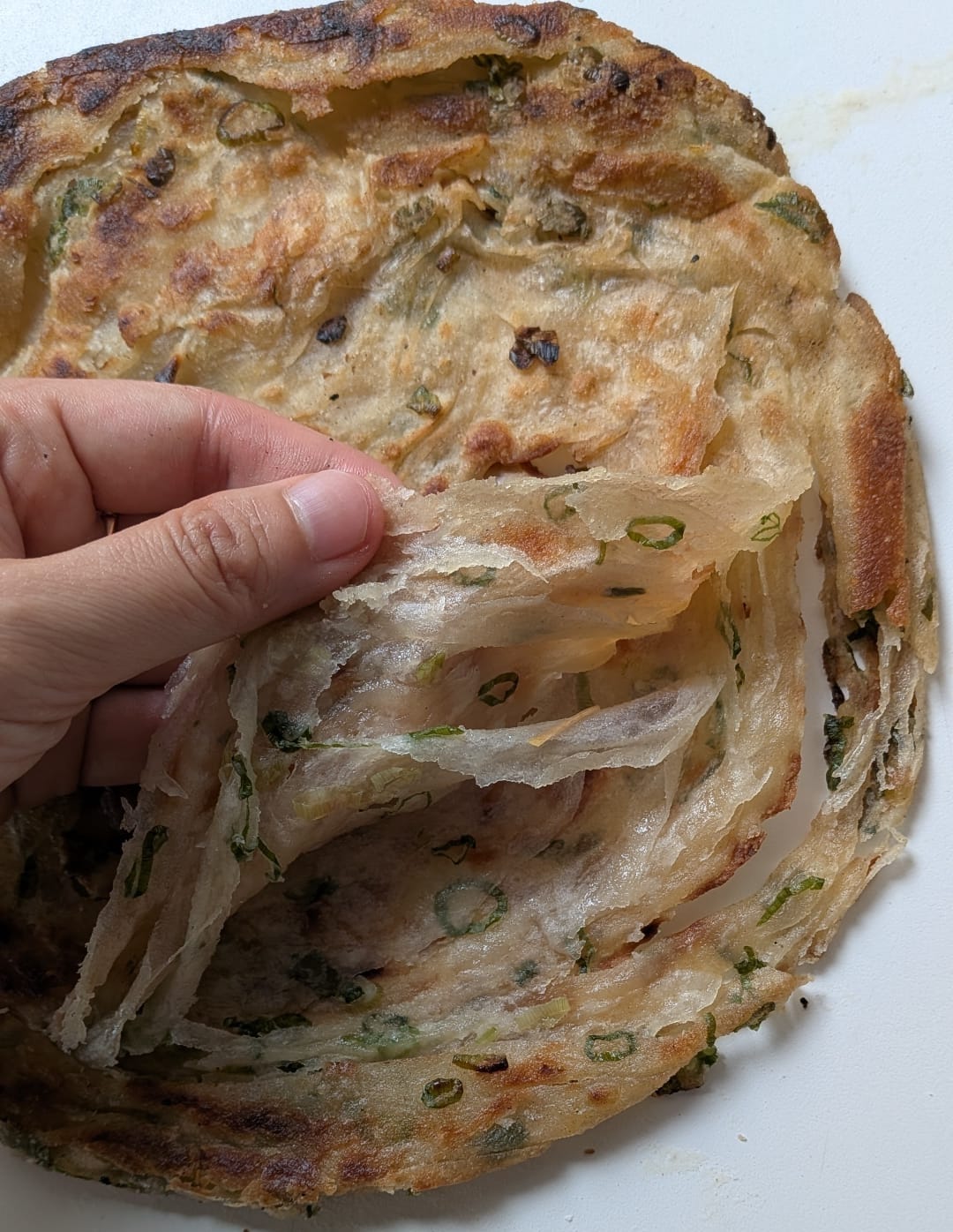
scallion pancakes 葱油饼
(a recipe with five ingredients that you probably already have at home)

Welcome back to the Singapore Noodles newsletter! Before we get to this week’s recipe, a note on PlantAsia. If you’ve been enjoying these weekly deep dives into recipes, techniques, and food history, you’ll probably enjoy PlantAsia as well. The book follows the same curiosity — combining recipes with stories, ingredients, and the cultural traditions behind them. The original self-published edition is still available on my website. Once the remaining copies in Singapore are gone, I won’t be replenishing stock, and this edition will not be reprinted.
Thank you for reading, and now onto this week’s recipe.
SCALLION PANCAKES 葱油饼
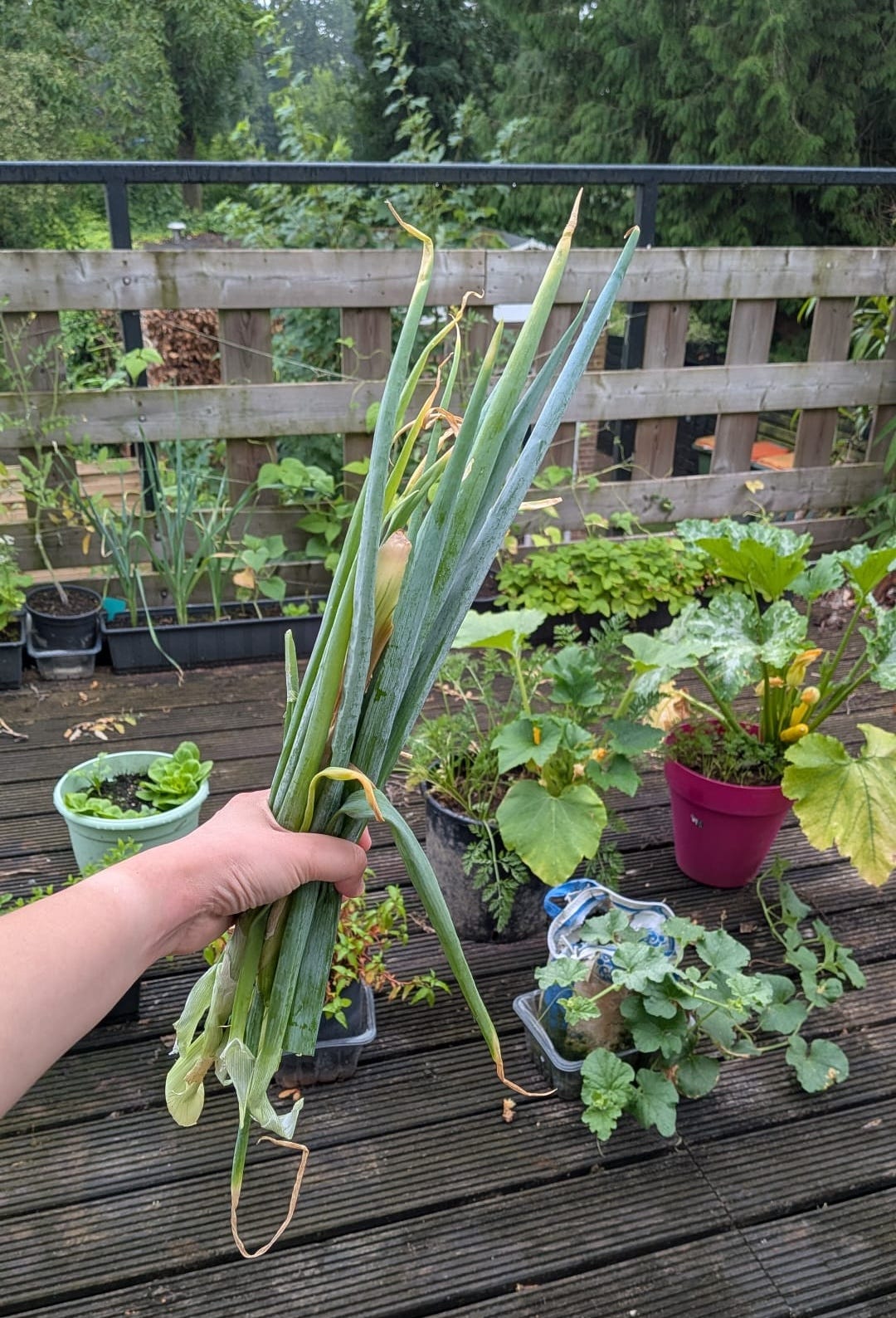
The pleasant weather of late has meant that our garden is now in full bloom. Our spring onions, in particular, are thriving, so Wex proposed some scallion pancakes. These are not true pancakes in the Western sense — they are studded with sliced spring onions, and come closer to crisp flatbreads with tissue-thin, tender layers within.
Like other food items that involve simple ingredient lists and cooking techniques, scallion pancakes go so far back in time that it is difficult to pinpoint their origin. That said, Chinese Menu: The History, Myths, and Legends Behind Your Favorite Foods by Grace Lin suggests a connection to Shanghai. As a trading port with a large population of South Asian descent, the flaky, layered scallion pancake might have emerged here, inspired by the paratha that the Indian immigrants were accustomed to eating.


Unlike paratha, scallion pancake traditionally relies on a hot water dough. The goal is to achieve a dough that is easy to roll out, so that you get lots of thin, tender layers within each pancake. Adding boiling water to flour limits the formation of gluten, which is what causes toughness and elasticity.
Another way to reduce gluten presence in the dough is to use flour of a lower protein content. In fact, many recipes for scallion pancake online call for a mix of cake flour and plain flour. Unfortunately, cake flour isn’t at all common here in the Netherlands, so I replaced part of the flour mix with cornstarch, which contains no protein.
Once the dough is made, it has to rest overnight in the refrigerator so that the gluten has a chance to relax. Given the long rest in the refrigerator, brushing the surface with oil is key to prevent the surface of the dough from drying out.


Scallion pancakes are a sort of laminated pastry — the dough is rolled out into a thin sheet, then fat and spring onion is spread all over, and the sheet is then rolled up and coiled to create many thin layers. I’ve seen two approaches: the first distributes oil and fresh spring onion between the layers, while the other uses an “oil roux” (油酥). At its core, the oil roux is flour scalded with hot oil, resulting in a thin, fragrant paste that can be spread over the dough. For fragrance, the spring onion can be added to the mixture to be scalded as well.
I was curious about the differences between the two approaches, so I prepared two pancakes using the same dough — one layered with oil and fresh spring onion, and the other with the spring onion-infused oil roux.


Once fried, the results were astounding. The pancake with fresh spring onions didn’t roll out into as neat a circle compared to the pancake with the oil roux, and the flavour of spring onion was greener and more pungent — which could be a good thing, depending on your personal preference. That said, the layers stuck together rather than being separated, so the overall texture was tougher and gummier.
The pancake with the oil roux really surprised me — the presence of flour allowed the layers to be clearly defined and the the pancake was super crispy and pastry-like. That said, the spring onion flavour was a little more subtle. This was an easy fix: I added some chopped fresh spring onion to the wilted spring onion and oil roux mixture for a stronger fragrance without the spring onion getting in the way of rolling the dough out.


Scallion pancakes vary widely in thickness, depending on the variant (thicker pancakes offer a chewier, more substantial bite). I experimented with two different thicknesses: thin (with the pancake measuring approximately 24cm across), and thick (13cm across). While thin pancakes could simply be fried uncovered on both sides until they turned brown and crisp, the thicker ones had to be cooked covered and over low heat, so that they could cook through thoroughly. For the latter, it was crucial for the oil roux to be spread thinly to avoid a sandy mouthfeel.
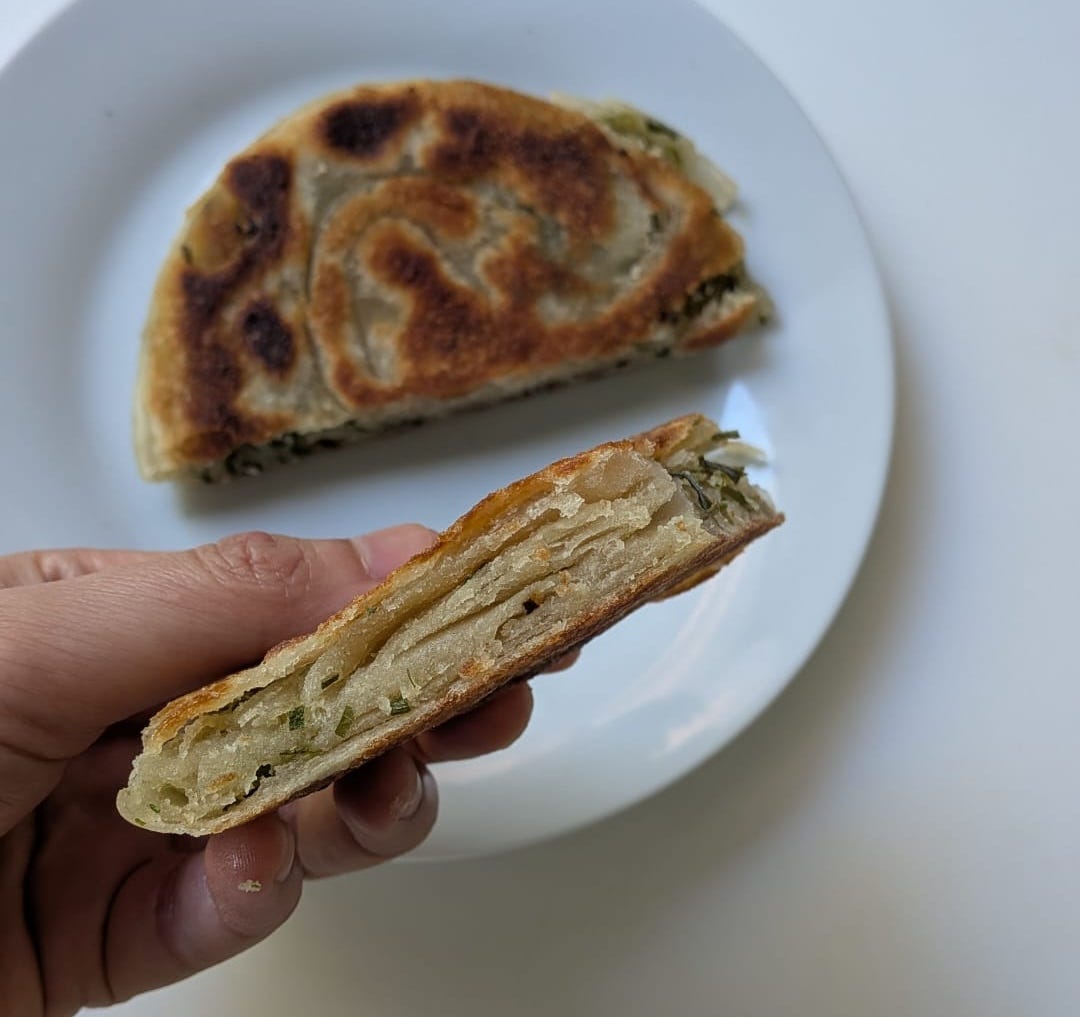
In the end, my preference is for the thinner pancakes. Once you have them rolled out between parchment sheets, you could freeze them if not enjoying immediately. Simply pop them into a pan with a bit of oil, over low heat, without defrosting.
Scallion pancakes 葱油饼
Makes 6 pancakes | Vegan